Conversation with Maria Klonaris and Katerina Thomadaki:
Dissident Subjectivities: The Filmmakers as a Double Subject
Marina Gržinić • 30.11.2025

Chutes, desert, Syn (1985)
Maria Klonaris and Katerina Thomadaki are among the most famous avant-garde artists working in France. Their collaborative work combines experimental film poetics with radical feminist theory, a reflection on intersexuality, and strong theoretical inputs on the formation of political subjectivity and on the role of the arts in today’s world. Experimental film remains at the core of their work, however, and since the mid-1980s they have been increasingly crossing film with photography, video, digital images, and multimedia projects. Rethinking women’s identities, reworking female agency and reconceptualizing the nomadic body are constant topics for Klonaris and Thomadaki. More particularly, the question of the “dissident body” as a counter-subjectivity of the body that thinks and acts, rebels and disrupts, but also disfigures, is at the basis of their interaction with issues of gender, reproducibility, equality, and difference.
Klonaris’ and Thomadaki’s “dissident bodies” force us to see defamiliarizing modes of perception, new paradigms of memory and loss. The artists produce eroticized, emphatic, and longing disfigurations of the body, deeply rooted in the social and natural environment. Exile and alterity are the main positions of the politics of the body they develop. Their path is a query about the position of the human within sexual, physical, and spiritual relationships. Their creatures bring to the fore the unstable and tenuous nature of “gender” in itself. In short, most border identity events take place in the perspective of radically performed stereoscopic visions.
Klonaris and Thomadaki create an immersive mental space, where the human body – intersexual or female – meets with the outer space. They tend to provoke both a confrontation and contact between visualized bodies and the spectator’s body. Within this confrontation/contact, some “monstrosity” is waiting to be reversed, re-imaged, re-imagined. The work deals overtly with the relation between gaze/screen/image/mirror. Here the gaze as a concept is central to the description of the subject’s psychic engagement with the cinematic apparatus. Even when their work abandons the cinematic apparatus to move towards exhibition space, the relation between gaze/screen/image/mirror remains central.
Klonaris’ and Thomadaki’s dissident bodies are critical of liberal capitalism and the accumulation of capital, which is the process of pinning down identities of certain bodies in time and space. Their juncture of art, culture, and politics reflects how artists, intellectuals, and activists intervene within culture and politics and how they try to make visible and reverse the logic of capital in a critical way. Reacting to the horror of exile, of brutalized migration, and to the penalization of alterity is equally a fundamental political position for them.
The result is a politics of ideas, and not an ontology of beauty. At work in Klonaris’ and Thomadaki’s universe is not simply an exhaustion of imagery or a simple cloning of images, their work pays attention to the technology of reproducibility as an important source of new possible future subjectivities.
MG: Where does your artistic practice meet your life?
MK/KT: Our artistic practice IS our life. There is a high degree of personal exposure in our films, particularly in our first cycle of works, The Body Tetralogy (1975-1979). These are practically autobiographical films and film performances, even if they entirely dismiss pre-existing narrative structures like those of documentary films, cinéma vérité, film journals, etc. Each one of these pieces (Double Labyrinth, 1975-76, The Child Who Peed Glitter, 1977, Soma, 1978, Arteria Magna in Dolore Laterali, 1979) is a structural invention where personal and collective experiences, memories and desires are transposed in ritualized stagings of our bodies and faces. Sometimes autobiographical materials appear in the form of texts, that we read live during the projection through a microphone among the public (The Child who Peed Glitter, 1977). In these four works of The Body Tetralogy, where we are the only performers, our bodies become projection screens of our unconscious and our mental structures. From A to Z the process is “non objective.” We are installing ourselves as “viewed women-subjects,” as a double subject, through an overtly subjective film language.
MG: You co-sign your films since the mid-1970s and you have underlined the idea of a “double auteur femme.” What is the history of this double signature that you have maintained for more than three decades?
MK/KT: We met in high school in Athens. The mutual discovery of our works (Katerina’s theatrical performances and Maria’s drawings and paintings) was an overwhelming emotional experience for both of us. A shock. This was an encounter for life.
Soon after, we started working together. In our university years in Athens, we created a theater group and put on plays like The Maids by Jean Genet (1968) and Salomé by Oscar Wilde (1969), directed by Katerina who also performed main parts (Claire, Salomé…) and with set designs, lights, costumes and make-up by Maria. Our experimental approach developed into a new formation, the Space for Theater Research, which we founded in Athens in 1972, a laboratory where we explored the limits of theater. In this context we started merging the distinct functions of director and set designer. When we came to Paris in 1975 for postgraduate studies, we oriented our practice towards performance and film.
It is then that we assumed our double signature. Double Labyrinth (1975-76) is the first film we shot in Paris and that we co-signed. Our double signature meant our equal involvement in the genesis and the making of the film. It also implied a common vision, due to an intense mental kinship, in spite of our quite opposing personalities.
It is true that we share many common points in our personal histories: same age, same maternal language (Greek) and same acquired languages, same initial religion and social solidarity principles, a middle-class background where education was the major commodity, same city (Athens), same Greek-American high school in our adolescence. We have also undergone together the political traumatism of the colonels’ dictatorship in the late 1960s and early 1970s. However Maria came from the Greek diaspora and grew up in cosmopolitan Alexandria, with Egypt as her original land and English as the first language she was taught to read and write. In her childhood she suffered the traumatism of the exodus after the Suez Canal crisis, when her family decided to migrate to Athens. Katerina grew up in Athens, a city “under (re)construction” after the German occupation and the civil war, her parents came from the islands – Crete and Naxos. Our migration to Paris was motivated by political, social, and cultural conditions. We also wanted to undertake postgraduate studies in the arts and theater which did not exist in these particular disciplines in Greece in the 1970s. This passage implied a socio-cultural leap, a rupture and a synthesis on which we have been working all our lives.
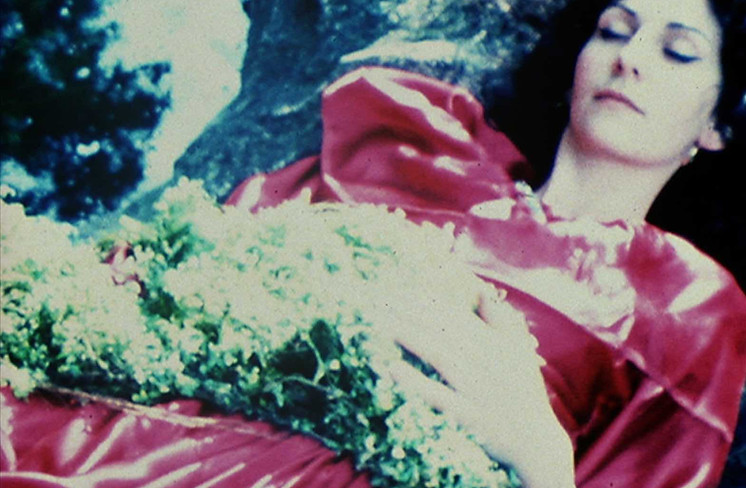
Selva. Un portrait de Parvaneh Navaï (1982)
Our first task in Paris, in order to survive existentially, was to construct ourselves as subjects. Intercultural subjects, women subjects, creative subjects, unsubmissive to sexual and artistic norms. The conception of ourselves as a “double auteur” contained all these dynamics.
The double signature came as the result of a long process and elaboration between us. We had to harmonize our personal necessities and temperaments. And it was not easy to let go of power residues implied in any relationship so as to achieve total equality.
We thus became a restraint collective. We already had a culture of collectives from our theatrical experience. The politicized praxis had at that time invaded experimental theater, but we still had to let go of our leadership instincts and all sense of hierarchy in the construction of our own relationship. The fact that we were two women did not necessarily resolve antinomies, because gender roles are complex anyway inside one single individual. But it certainly helped in the process. We had to invent a co-authoring ethics and this was a private creation, a thrilling experience, and a rewarding conquest.
With Double Labyrinth, we laid down the foundations of our Cinema of the Body and all the works to come. Along with our double signature, another “doubling” took place then. We doubled our roles in front of and behind the camera. Double Labyrinth has a mirror structure: in the first part Katerina performs and is filmed by Maria and the second part is performed by Maria and filmed by Katerina. This meant a rejection of the fixed cinematic roles of “subject” and “object” of the gaze (traditionally the subject being male and the object being female). We introduced the term “actante” (grammatically feminine) to signify our function in front of the camera not as “objectified” actresses but as “looked at subjects.” Each actante acted out and staged her own unconscious. This is how we initiated our apparatus of reversibility of the gaze and our intercorporeal apparatus.
In other words the new cinematic subject that we introduced and underlined – an alternative, “non-neutral” subject, a dissident subject, TWO WOMEN filmmakers as a double subject led to further reversals which, in parallel to our films, we articulated theoretically in the various texts and manifestos we published at that time.
MG: In fact, what does the double subject double?
MK/KT: The double subject enhances the awareness of the importance of dialogue. It doubles perceptions of the world and of the self, consciousness, sensory aptitudes, visions, mental wavelengths, personal experiences and desires but also relational politics.
Together, we are constantly in dialogue, exchanging and sharing experiences and ideas. Our double signature means that a fundamental connection is at the center of the cinematic process. This overthrows the profoundly rooted idea of the One and all powerful male director as only legitimate “auteur.”
Our relational politics, active during the conception and the making of each film, were partly extended to the other women actantes in our films. We also applied some of our principles (the reversibility of the roles filmer/filmed, the actante, the collective processes in editing, etc.) in the various cinema workshops for women that we led during these years.
On the other hand, throughout our intensely filmic period, which runs roughly from the mid-1970s to the mid-1980s, we were able to thoroughly develop our connection with audiences. During that period, our main productions were feature length Super 8 films and multi-screen expanded film performances. We have conceived them all as live events. The performative dimension is crucial to us. We rarely sent a film to a venue without accompanying it ourselves, presenting it, projecting it, and then extensively discussing and exchanging with the public.
We wanted to create laboratory situations: we projected our syn-subjectivity to viewers as an open system into which each of them had the space to project in exchange her/his own subjectivity. As a social process, our practice takes its full meaning through the audience’s experience. The numerous ruptures operated by our film works called for an exchange with the public, even if this were risky for us in terms of personal exposure and vulnerability. In our eyes an audience is never a general or statistic fact, but a mosaic of concrete subjects. In fact we want to know who they are and what they experience while watching our films, how the films interact with their lives and how the viewer’s subjectivity unfolds into our images.
We thus discovered to what extent the films acted as social, mental, and visual agitators. On the one hand, the exchanges we provoked with the public revealed the tenacity of the cinematic norms which we were consciously disrupting, the social norms regarding gender which we were attacking and the cultural clash that we were provoking with film works which came from hybrid cultural origins and histories. On the other hand, these debates carried the extraordinary political energy of that period and the active search for alternatives: our cinema, our lives and our double signature were part of them. The films shattered some certainties, raised personal questionings, unveiled desires and encouraged creation experiences. To strongly committed feminist audiences we tried to communicate the importance of cinematic alternatives and visual inventions. To avant-garde filmgoers we tried to communicate feminist awareness. All this generated battles as well as passionate encounters. We learned a lot from our spectators. Their openness and sensibility helped our work grow and their resistances allowed us to test the tenacity of norms and frontiers in the mind.
We liked to challenge limits and dig deeper to the very point where the perception of the film seemed to meet an obstacle. For example, for a feature length non-narrative film, duration is an obstacle, as experimental films are generally identified as shorts. Silence is another frequent “obstacle.” The audiovisual character of film is a deeply rooted cinematic norm. Double Labyrinth is a 55minute-long silent film and spectators often reported this silence as “unbearable,” in relation of course to the content of the film and its interior tension. We wanted to dig deeper into this “unbearable” and went on producing featurelength silent films and performances, until the spectators would let go and accept the immersion into the music of silence. The inner space and time of our films are enhanced by silence, as with the three-hour-long silent film Unheimlich II: Astarti (1979-80), which is our most far-reaching experiment in duration and silence.
What does a double subject double? Communication risks and adventures, but also determination, endurance, empowerment.

Unheimlich II: Astarti (1980)
MG: Such a double subject allows fighting binaries and forming a practical theory and an artistic practice to resist the violence of heteronormativity. You have put forth a certain program of politics, which is queer and feminist. Where does it come from? Where and when was it developed? On which points does it reside in a certain double history of art and of your lives?
MK/KT: Before becoming, as you say, a program, it was a life urgency. A politics in acts. Acted in our own bodies in our everyday life.
When we arrived in Paris and made Double Labyrinth in 1975-76, we curiously had not heard about the feminist movement although we were pursuing postgraduate studies in the arts (including experimental film) and the theater departments of La Sorbonne. This demonstrates to what extent the feminist movement, in its most vital years, was left outside the academy in France. We met the movement in Italy with Double Labyrinth, which was considered by Italian activists as a feminist manifesto.
It is then that we started getting acquainted with women’s political groups and theories of that period – Cixous, Irigaray, Kristeva, Wittig. With the text accompanying Double Labyrinth and with our widely published “Manifesto for a Radical Femininity, for Another Cinema” (1977) we laid down the theoretical foundations of our feminist position, which drew together two necessities: the reinvention of the “feminine” and the re-invention of cinematic alternatives. We proposed a gender-inclusive, empowered “feminine,” opposing, among others, the Lacanian concept of the feminine as “lack.” This proposal went along with a film practice out of/against the cinematographic system and its heavy masculinist infrastructure. We also defended the “political dimension of poetics” a question generally eluded by political movements.
At that time, psychoanalysis was at the front stage. Our contestations of the naturalized “feminine” and our preoccupation with the unconscious as well as the analytical dialogues we promoted were recognizable territories to audiences and scholars. With our film Unheimlich I: Secret Dialogue (1977-79), recently restored in 35mm by the French Film Archives/CNC, we introduced the concept of the Freudian Unheimlich, which at that time had not yet fueled the extensive discussions that we know today. In our reading of the Freudian essay we saw a subterranean link between the uncanny and the feminine. This provided the theoretical postulate underlying our feature-length films of the Cycle of the Unheimlich, Unheimlich I: Secret Dialogue (1977-79), Unheimlich II: Astarti (1979-80), Kha. The Embalmed (1979-80), and Unheimlich III: The Mothers (1980-81). In these films, we stage the “feminine” as “uncanny.” At the same time “uncanniness” characterizes our “unfamiliar” film poetics.
Our involvement in the early 1980s with a Lacanian research group exceptionally composed by women and led by Eugénie Luccioni-Lemoine brought us closer to the psychoanalytic milieu in Paris. However, our gender politics and our double authorship as women clashed with the naturalized heteronormal foundation of the Freudian heritage.
When at the beginning of the 1980s we introduced the figure of the hermaphrodite with our projection environment Mystery I: Sleeping Hermaphrodite at the Museum of Modern Art within the 1982 Paris Biennale, we stood apart from the surrounding feminist movement which was still mainly preoccupied by the “feminine.”
In the mid-1980s a crucial “encounter” from the past came to the surface. In her adolescence Maria had discovered an astonishing anonymous photograph of an intersexual in the archives of her father, Dr. G. Klonaris, an obstetrician and gynecological surgeon. The blindfolded figure had made an overwhelming impression on her, an impression shared by Katerina later on. The photograph came with us to Paris but stayed in a latent state until our reflection on gender involved the hermaphrodite. In our Paris Biennale installation, which opened the Cycle of the Hermaphrodites (1982-1990), the central figure was the mythological hermaphrodite as it is represented by the Sleeping Hermaphrodite Hellenistic statue of the Louvre. Shortly after, the real body of the medical archive intersexual figure emerged powerfully in our vision. We called her/him Angel. We started reworking the medical photograph superimposing it with astronomic landscapes. The projection performance Mystery II: The Angel Ablaze (1985) introduced The Angel Cycle (1985-…), a vast series of works that is still ongoing today. Both the concept of intersexuality and that of the angel were once again alien to our artistic and intellectual milieu. The queer movement had not yet emerged as such at that time. We first heard about it in the early 1990s in London, when we created our Night Show for Angel (1992) monumental installation in the Hornsey Road Baths’ abandoned building. Since then we have been reelaborating the feminist-queer connection, but as free electrons, within our own poetic, theoretical and aesthetic system.
Where do our feminist and queer politics come from? Certainly from the degree of repression we had absorbed in Greece, due both to dictatorship and to social and family conservative conditions. Such a repression inevitably creates victims or rebels. We were not victims.
MG: Feminism is today split from within. The white heterosexual feminists from the past cannot understand the revolutionary positions brought by the black body, immersed in processes of migration, anti-racist politics, decoloniality: bell hooks, Grada Kilomba, Gloria Anzaldua open a different platform for politics. Where do you stand with your work in relation to this?
MK/KT: What is so difficult to understand? That there are degrees of brutality and that black bodies and more particularly black female bodies have received (and receive) a much higher degree of brutality than white Europeans or Americans do? And that this is a fact that no one can elude and which necessarily transforms our views and our theories? We are totally concerned with all these struggles. Besides, migration, racism and coloniality take constantly new forms and really explode at present. See for instance the ferocity of the new forms of intra-European neoliberal colonization unleashed on the populations of “bankrupt” countries. Not to mention the new forms of racism brought up by forced flows of migration from the East and South. Wherever one may live, in any country, in any “degree” (or pedigree) of “world,” “first,” “second,” “third,” etc…, one is necessarily touched by these processes in one’s everyday life. We believe all struggles, past, present, or future should stay connected in one way or another. One single person, artist, theorist, or activist can probably not engage in all, but the essential is to engage at least there where the pressure is most unbearable in one’s own life.
In this sense we have rarely dealt with the black question in our films. However, in Arteria Magna in Dolore Laterali (1979), a multiple projection performance, we overtly raise the question of sexual mutilations on African young girls. Otherwise, we have often worked with mixed origin or métis performers like Parvaneh Navaï or Syn Guérin, as well as Mylène Glykou, a protagonist along with us in Kha. The Embalmed (1980) by Maria Klonaris (one of the rare films that we did not co-sign, but to which we had collaborated for the editing, the camera, the performance, etc.) Kha means the etheric double in Ancient Egyptian and the word “embalmed” (which in French we apply in the feminine gender) has the double meaning of embalming the dead and of being fragrant.

Flash Passion (1982)
MG: You work with figures, among which two are particularly important and reoccur as a political program: the hermaphrodite and the angel. Sexuality in them is a key point. Can you explain what these two figures stand for? What kind of sexual alternative do they propose to us? And in which way can we understand their politics?
MK/KT: In terms of Greek mythology, the hermaphrodite (a masculine noun in Greek) was the result of the merging of two oppositely sexed bodies into one. The hermaphrodite is a sexual synthesis, a composite sex figure incorporating female and male visible sexual attributes. Now, if we consider real human bodies, hermaphroditism or pseudo-hermaphroditism are variations which occur in different layers of the biological construction of sexual identity and involve inhabitual combinations of the two sexes. The term “intersexuality,” invented by Havelock Ellis in 1897 and which came largely in use in medicine in the 1950s, enlarges the concept of hybrid sexual identities to all kinds of departures from the dichotomic masculine/feminine pattern, presumed “normal.” This covers a large scope of anatomic, hormonal or genetic discontinuities, including chromosomic variations mixing the two sexes, more often referred to as mosaicism, another term that we have used in our work, in particular in our Linz site specific installation of 1994 entitled XYXX Mosaic Identity.
The research that we undertook in the mid-1980s when we started working on intersexuality, once more confirmed the methods of the brutal inscription of binary sex “normality” on “outlaw” bodies, to use Foucault’s expression.
However, the intersexual figure that we had discovered did not convey suffering, but a majestic distance, a proud “standing up” and emanated a powerful eroticism. S/he was literally sublime. As a medical document the photograph was exceptional. This clinically observed body, which combined a feminine external sex and a male anatomic construction, seemed to resist objectification to which usually the medical gaze reduces subjects under the pretext of scientific “objectivity.” On the contrary, a curious reversal was taking place: the photographed subject transgressed the medical context and unveiled the limits of the binary sexual norm. We associated her/him with the angel. The sexual ambiguity of this figure subverts standardized sexual difference as a biological and social construct.
For us, this real body inscribes within human histories a private and public dream of the late twentieth century, the dream of a shift from the rigid dichotomic sexual pattern, responsible for so many exclusions and damages, to a complex, inclusive perception of sexual identities. The opening up of physical and social frontiers of sexes means the acceptance of an elementary and major freedom: the freedom to live and experience one’s sex and sexuality as multiple and moving.
MG: You talk about alternatives brought about by queer bodies and by the medium of experimental film/video art. How do these alternatives question the biopolitical in general, especially the biopolitical of the institution of art present in the last decades. The institution of art is a frightening bureaucratic machine without alternatives.
MK/KT: We would say with fewer and fewer alternatives, but not without any alternatives at all. This is why we can presently work creatively with some institutions that still allow freedom and respect for artists and art works, like for instance the Archives Françaises du Film/CNC with whom we have a rare collaboration for the restoration of our Super 8 films in 35mm. Besides, all the people employed by an institution do not necessarily identify with the institutional politics. There may be resistance or at least frustration from the inside. Of course, the more an institution is “central” and rich, the more it is pervaded by power conflicts, snobbism, arrogance, and deafness to non-canonic art, whatever the canons of the moment may be. Since the 1990s, art institutions conform more and more to commercial objectives and market policies under the pressure of advanced capitalism’s globalization as you have yourself often underlined. This is clear when we compare to what was happening in the 1970s and 1980s. For instance, we have had various commissions by the Pompidou Center at that time – its golden age – when the institution was still “open” enough to bring center stage emerging critical thought and art works that came from alternative scenes bursting with inventions and political energy (i.e., experimental film, video art, etc.). Therefore the cultural institution could act as a mediator for critical art and ideas. Ah! The happy days!
To go back to your question about the alternatives we cherish and how they question the biopolitical. With our work we stage female bodies and subjects through a non-heteronormal consumerist or voyeuristic gaze and ideology. On the other hand we focus on extraordinary bodies, currently considered as abnormal or even “monstrous,” like the hermaphrodite, the “angel” or the nineteenthcentury conjoined twins in Sublime Disasters. The Twins (1995-…). We call them dissident bodies.
However, within current media language and trendy first-degree sensationalism, this kind of political position is undesirable and “illegible,” to use Judith Butler’s expression about gender complexities. This “illegibility” reoccurs in various theoretical fields, as for example that part of film theory which has not yet revised its profoundly machistic, voyeuristic, and normative consideration of bodies, in particular female bodies and their figuration in cinema.
Now what happens with the spectators is entirely different. This spring, In Athens, we presented an environmental installation commissioned by the Onassis Foundation for their inaugural exhibition. According to our architectural plans, a specific space was constructed, where our digital video Quasar (2002-2003), one of the “extragalactic” pieces of The Angel Cycle, was projected on the central screen while extending into the space through multiple projections on the walls and ceiling, as well as through mirrors. In Quasar our own faces and eyes merge with astral worlds and energies. The organization of the projection space is ritual. The sound is diffused in crossed stereo and the exceptional technical projection and sound conditions enhance the images’ and sound’s presence.
While in Athens, we witnessed a strong response of the general public, in spite of the intensely subjective and experimental character of this work. Systematically, the spectators reported an overwhelming emotional experience and often pressed their chest as if something had directly struck their inner being, their heart and breath. Something psycho-physical. Some referred to eroticism, others to an “echographic” experience of a cosmic conception. These reactions came from women and men of various generations. Children spent much time inside the space, which both relaxed and scared them, some of them said they preferred it to the planetarium! The public’s response moved us and intrigued us. What exactly did this work activate? A shared unabolished connection with a multilayered time/space perception? Cell memory? Underskin poetics? Pythagorian reminiscences?
MG: I would like to bring up the dimension of time in your work. Your treatment of intervals and repetitions provokes a disorienting experience of time. How do you conceptualize time in your work, what is time for you, and what kind of time do you use to construct the “subjectivity” which characterizes your films and videos?
MK/KT: We work with states of modified perception. The time-space in our films, videos, and installations is never “realistic.” Causality and chronological time are replaced by a “transfigured time” (Maya Deren’s expression) which allows free circulation within inner spaces.
We have always been interested in interior temporalities and time perceptions, in time extracted from the everyday perception norms, in temporal estrangement. This focus does not mean an indifference to historical time, but an attachment to temporalities which are culturally marginalized, although vital. Temporalities of dreams and visions, temporalities of memory, imagination, and desire. We often create immersive hypnotic states which imply non-linear and non-hierarchical time structures. In our films and projection installations we have worked a lot on circularity or reversibility of time. Time is a tissue that can be weaved in many manners within time media. Electronic and digital media enhance its plasticity.
This is why our works are generally constructed outside of historical time, although we may use historically situated documents, i.e., the presence of World War II newsreels in Requiem for the XXth Century, a video we made in 1994 during the Bosnia-Herzegovina war. In that particular case we did not want to use found footage that was contemporary to the making of the film, but materials that have already imbued collective memory.
The interval and repetition patterns that you evoke, reflect poetic or musical patterns of recurring strophes and motives. Repetition and variation may also change cerebral wavelengths.
Possibly our conceptualization of time has to do with our life experiences. From our respective childhoods in Greece and Egypt we have been exposed to a multi-layered and diachronic awareness of time and its collapses. The fascinating or haunting ruins and survivances present in our everyday life environment sensitized us to the moving depth of time running from the neolithic to classical ages and from the Hellenistic years to the Byzantium and more recent times. Survivances include ancient rituals still performed today. Ruptured but boundless time is another face of ruptured and boundless cultural mixtures. The moving depth of time runs from past to future, from body to out-of-the-body perceptions.
In our recent digital works, where we extensively use astronomic references – scientific photography but also energy and time patterns – we explore dimensions of the infinite as an intracellular experience and a state of the mind. Repetitions and variations mix with genetic 3-D curves, like the ones of our two faces dynamically merging and mutating in Quasar.

Quasar (2003)
MG: Is doubling a question of repetition? After all, what does repetition mean in relation to your work, and do you expose it as a dimension of agency?
MK/KT: The double subject is not repetition but combined difference. Repetition is echo and mirror, it is rhythm and circularity, it is haunting and obsession, it is incantation and ritual, it is hypnosis, it is disruption of evolutive time, it is breath and heartbeat. It is the profound structure of memory and desire, and, possibly in that sense, a dimension of agency.
MG: Performativity is a crucial factor in your work. It seems to develop in two directions: the one is you as performers in the early works and the other one is the re-performing of your work, for example your way of going back to your films and your commitment to their restoration. Can we discuss this?
MK/KT: Our performance work is conceived for the camera and addressed to the camera. We are not gallery performance artists and our films are not “filmed performances” – apart maybe from Double Labyrinth where we keep the time-space unity of each “action.” Immediately after, we broke up this unity, by the use of slides or closed circuit video alongside film, as well as multiple screens and complex editing principles.
Stylistically, the performances in our films owe much to our prior theatrical experience and to our interest in rituals or traditional Oriental theaters like, for example, the Noh. We never use acting devices – no role playing and no psychological expressivity. We perform in silence gazing at the camera, and through the camera (exclusively held by us two), gazing at one another and, in extenso, at the spectator. Our Double Labyrinth performances have many affinities with the Body Art of the 1970s, with which we established a dialogue through this film. After The Body Tetralogy, with the Cycle of the Unheimlich, we moved away from Body Art into more cinematic structures. And our recent Angel Cycle performances are tightly woven with digital technologies’ transformative potential.
Our performances are explorations of the self and iconic translations of inner dimensions and experiences. The fact that no one, apart from us filmmakers and the performers, is present in our shootings, gives us maximum freedom of expression. Once again a laboratory situation, an intimate laboratory of self transmutations and revelations where the camera lens acts as a magnifying glass.
The act which we do perform live among the public is projection. Our theory of corporalization of the projection implies our presence, the presence of our own real bodies among the spectators. This is an additional exposure and additional tension and risk, as we always work with precise projection scores which do not tolerate equipment deficiencies. Our expanded film performances grew more and more complex and reached a climax with the ten projectors piece Unheimlich III: The Mothers, commissioned by the Pompidou Center in 1981 and presented in the Museum’s cinema for two weeks. Or the much screened Hermaphrodite II: Orlando (inspired by Virginia Woolf’s homonymous novel), a fresco for seven simultaneously projected images which, in its inaugural performance, we orchestrated seated on the stage of the theater auditorium of the Pompidou Center equipped with a 20-meter-long screen (1983). The technical complexity of these projection performances, along with the disappearance of the equipment for which they were conceived (Xenon Super 8 and slide carousel projectors) make them practically impossible to re-perform as such today.
Are they definitely “lost”? Are they destined to survive through fragments, stills, textual testimonies, and spectator’s memories? Or can they be technically retrieved one way or another? They certainly cannot be re-performed by anyone else, as they rely on memorized scores and not written descriptions – and on our presence, whatever the word presence may encompass. By the way, we think that the recent trend of re-performing body actions from the 1970s is problematic, because these works are inextricably woven with the presence of the artist who conceived and performed them in the hic et nunc. Presence means also inscription of personal history and subjectivity as well as historical context on the artist’s own body. The density of concentration, the subject tension between conception and performance generate a dramatic effect which is unique. No one can shatter a glass leaping through it the way Gina Pane did! In some cases, “replaying” is pointless.
On the contrary, the other “rescue” process, to which you refer, film restoration, may be rewarding. Why this commitment to the restoration of our films? Maybe because the meta-life of our ephemeral works has always preoccupied us, and parallel to our creation we have been keeping and constructing traces, records, and extensive personal archives.
Since 2003 we are involved in an innovative initiative of the French Film Archives/ CNC which consists in the restoration in 35mm of our non-narrative Super 8 films from the 1970s and 1980s. This implies considerable technical research, as current restoration processes generally cover visually standardized feature films. The first question that was raised concerned the format. Could Super 8 be successfully enlarged into 35mm? After the extraordinary results of the tests, the Film Archives, the technical team and ourselves concluded that it was possible. The next major question then was the aesthetic criteria that should be applied, due to our non-standardized, utterly subjective film language. This question was further complexified by the performative dimension of our single screen films. For example, in our Super 8 films, whenever we used sound, we synchronized image and sound through speed variators during the projection. Once again, no written scores, just memory patterns. It was obvious that this restoration could not be done in our absence. The Film Archives decided to entrust us with the direction of the restoration works. The process that followed was a thrilling emotional and technical adventure which implied to imagine solutions at each step. The challenge consisted of staying faithful to the originals, while amplifying their audiovisual input. This format leap granted a new visibility to our films, a literal renaissance.
We would like to underline here our commitment to the cinematic apparatus and its experiential power. As filmmakers and artists we strive to keep it alive. Since long we have been working on the transposition of the cinematic apparatus in visual arts’ spaces – museums, art centers, etc., in the form of environmental projection installations aiming to multiply its immersive potential. The considerable work that we presently dedicate to the restoration of our Super 8 films aims to preserve and enhance the auratic potential of cinematic images. The attention brought to the intensification of the visual components of the image, as well as our immersive post-cinematic spaces defy the reduced states of perception promoted by the most dynamic “new” medium, the network. Internet allows an unlimited connectivity, with doubtless political agency, but remains an information medium as opposed to what we could call an experiential medium. Live confrontation situations in art provide shared presence communication. Encounters and connections through crossed subjectivities may be a strong antidote to alienation and a fuel for life.
MG: I would like to conclude by asking you the question you yourselves ask in your powerful texts entitled “Film, Gender and Anthropology” that you wrote for the book New Feminism: To what extent is an artist or intellectual still allowed by contemporary society in which we live to develop independent critical positions? Or, I will say, dissident subjectivities, that you definitely constitute in life and you develop in your film/video works, in order to allow for another perspective of art and politics to form us here and now?
MK/KT: We want to believe that in spite of the shrinking of podiums for independent critical positions, whether these are artworks or philosophical, literary and research statements, there is still some room left for dissident subjectivities, and some more room to conquer, as long as we can adjust our weapons, build shields, adapt to harsher life conditions, and have the chance to survive!
We are aware that the worldwide landscape gets darker and darker and our lives more and more ruthlessly dominated by neoliberal capitalism that Achille Mbembe accurately terms “necrocapitalism” – as it increasingly produces the expropriation of life. You have underlined this in your own texts. The problem is who or what can stop necrocapitalism, when and how? Apparently, neither human suffering, nor massive demonstrations and popular upheavals, nor scientific warnings, not even the earth’s terrifying reactions have, up to now, succeeded to do so. Immense global disasters like the one at Fukushima continue to be viewed as “local accidents.” Let’s hope that harsh economic mechanisms of repression and destruction operating in the world will go on awaking collective resistance and will end up triggering drastic changes through, among others, ecological, anti-nuclear movements, etc.
Meanwhile, what we can do is become all the more aware of our personal and collective responsibilities and keep active in our scale defending critical positions, unsubmissive practices, alternative bodies, and re-invented selves – while remaining receptive to the world’s still existing splendors. Ultimately, it is maybe through them that we can invent new horizons.


