Interview With Ben Russell
Oliver S. Pérez • 26.05.2026

Black and White Trypps Number Three (2007)
Oliver S. Pérez: You have described your work as existing between documentary and ethnography. How did your early experiences and relationships with any particular filmmakers, artists, or anthropologists shape your thinking about form early on?
Ben Russell: It all started when I was in college. I attended Brown University in Providence, Rhode Island, where, in order to take film or video production courses within the context of the Modern Culture and Media department, you had to take at least one year of media theory and critical studies. So, before I had even picked up a camera, I had to read texts about everything from Foucault to how images are constructed and what they mean. I hadn't had any exposure to experimental cinema either. I grew up in the suburbs of Southern California and the most radical things that I had seen up until that point were probably Twin Peaks and MTV. It was at university when I really started watching films with a kind of critical eye. After taking these courses for a year, I enrolled in my first documentary film and history course. The ways in which media was presented to me created an immediate understanding of the documentary field as a construction, where everything was built and everything was a decision.
During this time, Trinh T. Minh-ha's Reassembled (1982) was a really important film to me. She talks about how, when you frame, you're not actually framing, and when you edit, you're excluding. To me, an anecdote that really points towards this is a note of Minh-ha, where she mentions that in particular, white women walk up to her after watching Reassembled and say, "It's amazing how beautiful the women in your film are. They're so well dressed." Her response to that is, "Well, they knew that we were going to be making a film, so they wore their best clothes." I would say that's how I understand the origin of my ideas about construction in relation to the image and the subject. At some point, this aligned with my studies in contemporary art practice, where the dominant idea was that the way you make a thing is also what you're making. I later understood that this concept really came out of structuralism, especially in avant-garde cinema. Those ideas all really led me towards an understanding of image construction as a set of relationships between subjects, myself, the on-screen subject, and the audience's subject, but also about the way that material and all of the forms of production determine the choices. For instance, if you have a million dollars, you'll make a very different kind of film than if you have sixty dollars.
I wasn't exposed to a lot of experimental work until I was in graduate school. I had the luxury of living in Chicago at that time where there's a lot of really great experimental film screenings. And it was there that I saw films like Michael Snow's work or Hollis Frampton’s. There’s a film that he made with Michael Snow, Nostalgia (1971), which is quite incredible. And also films like Chantal Ackerman’s D’est (1993), which is a kind of tracking shot that traces out the shift from one space to another space, one cultural space to another space. In the earlier stages I remember being quite affected by Louis Buñuel and Salvador Dali's Un Chien Andalou (1929), because that seemed to be a proposition for a really different way of thinking about narrative, or maybe it proposed that cinema was like a set of feelings or affects and not necessarily a continuous stream.
OsP: Do you see yourself as part of that lineage of experimental filmmakers?
BR: Yes, definitely.
I was first exposed to American avant-garde cinema in the mid-to-late nineties and would say I have a very encyclopedic knowledge of it. I mean, I've seen most of the stuff. I've also done film programming curation since 2003 and put together nearly 150 programs of films and short films. These are always based a bit on Amos Vogel's Cinema 16 programming. The Cinema 16 selections brought together really different kinds of cinema. So yeah, I definitely come from a lineage of experimental cinema, but my first exposure was to narrative cinema, like everybody else; to television series, music videos and documentary practices. When I started making experimental films, I would say that all of those were in it. There wasn't anything like a pure sensibility or pure approach. The insistence on 16mm as a form was something that typified a lot of experimental work before the mid ops. And even though I've only really ever worked in 16mm, I never thought about it as a thing that I have to do. It's just more the thing that I like to do. But, yeah, I'm still mostly interested in experimental work. Not just in cinema, but in music and performance as well. The things that I like are maybe more underground, more marginal, less narrative, and more visceral I guess.
OsP: Do you feel aligned with any particular tradition?
BR: I mean, it's a funny moment to be a filmmaker right now. I've made a lot of films, about forty shorts and five features and to me, they're all quite different in their ambition and their material approach. I think they're getting more similar now, because I don't have as many tools as I used to.
I’ve always been interested in being a part of multiple lineages; I don't see the point of staking a claim in one particular territory because I find what's interesting, and what's interesting about working with an experimental medium or experimental music, is pushing against the edges of the other works. I would say my work is somewhere in between experimental cinema and documentary. And sometimes I talk about the influence of ethnographic film practices in my work. But I'm not an anthropologist, and so I'm not beholden to ideas of science or truth or objectivity. In fact, I don't really believe in them.
But those are the spaces that are the most interesting to move towards, because they're the ones that, from my perspective, pose the most problems. And I think pure subjectivity and beauty are also not, like, very interesting in themselves.
OsP: Your projects, especially those in relation to ethnography like River Rites or He Who Eats Children, often emerge from a sustained engagement with the communities you portray. How does the duration of these relationships affect your formal decisions? And what does collaboration mean in your process beyond subject–filmmaker dynamics?
BR: When I was 22, I lived in a jungle village in Suriname for two years. I was a development worker, not because I wanted to be a development worker, but just because I wanted to have a pretty radical experience elsewhere and knew that I also wanted to continue to make films. I had the great fortune of living with a pretty unique group of humans, and I learned to speak their language and have been back a number of times over the years. Both those films you mentioned, River Rites and He Who Eats Children, but also Let Each One Go Where He May, Trypps #6 and Tjúba Tén (The Wet Season) are all films that were made with this particular community. I've made films in other places where I don't speak the language and can't communicate and it's less interesting. You miss a lot, when you can't talk to people about what's going on.
Having also studied postcolonial theory, I would say that one of the challenges of film-making has always been to give oneself license to make films. As a white, heterosexual American, my people have been on one side of the camera for a really long time — both sides, actually — and have been making decisions about how folks get represented for a long time. Although postcolonial theory has become sharper since the late nineties, the idea remains the same: that nobody really has the right to make images of somebody else. If you want to make images, you must figure out an ethical and moral way to do so that involves consent. However, morality and ethics are subjective, so I would say that the formal decisions are always meant to reflect my relational position. Shooting with a Steadicam creates a certain kind of distance in the subject-author-subject relationship. When you're able to get close to a subject, it means there's an accord between you. The subject is allowing you to be there. So, yeah, that's one thing to keep in mind. Then there's the topic of time, which has its own demands on the way it is approached. It changes from film to film. Hopefully. The challenge is trying to keep doing new things, you know?
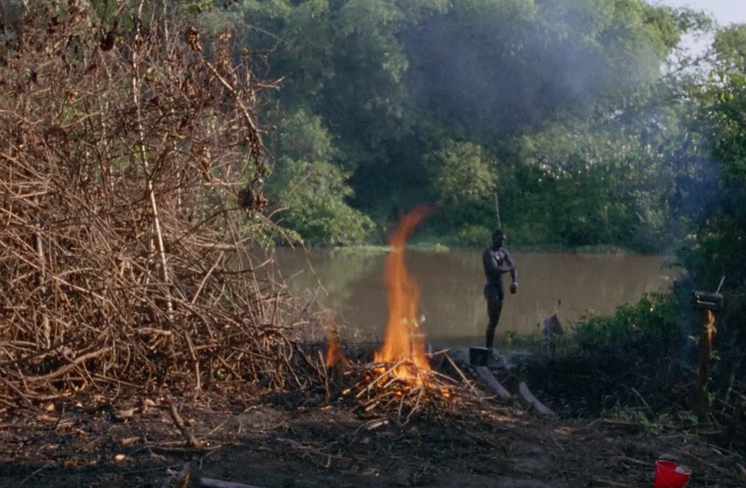
Let Each One Go Where He May (2009)
OsP: For time in particular, I've seen that a lot of your films privilege duration over editing, real time unfolding. What do you think duration allows you to access formally that montage cannot?
BR: I would say that the most remarkable aspect of cinema, or rather, the thing that interests me the most, is its capacity for a kind of time travel that simultaneously produces empathy. I don't think you can ever truly know a subject. However, if you spend time in their proximity, you can begin to understand them, and a relationship from your body to their body is sort of produced. That only happens with time. If you have a long take, you're asked to exist within a space of gesture, repetition and movement. For example, in a film like Let Each One Go Where He May it allows you to kind of walk next to it, not in front of and not behind, but nearby.
Montage suggests a really different kind of time, and I don't think that one is better than the other. I've made films that have really intense editing in them, but I think the long take is especially well suited to portraiture. By portraiture, I mean not just human subjects, but also the spaces they inhabit. Those spaces are places where time is relative. For example, jungle time is very different from city time. It's really different from concert time. There are all these different temporalities that exist. When I was living in Suriname, I was most conscious of this because it was a space without electricity or running water or cell phones and, you know, time was a lot more seasonal. So you are asked to pay a different kind of attention.
I once saw a film, but I forgot who the filmmaker was. It had a lot of walking in it. It was sort of like Jean Rouch's Jaguar (1967) and films by Chantal Akerman. Then 10 Skies (2004) had a profound effect on me. Returning to the idea of time travel, when you're faced with a long shot in cinema, you are simultaneously in your body and in the shot. It's as if you're occupying those spaces simultaneously. Gene Youngblood talks about this in his work Expanded Cinema (1970), contrasting the passive and active viewers. I feel like the durational image creates an activity within the viewer, making them aware of themselves. People talk about that as boredom, right? And boredom is really just a consciousness of the self, which then implicates everybody else in the space, like the people around you, and how sound is operating, how the image is moving. Narrative cinema generally wants you to be unaware of that. It doesn't want you to be conscious or self-aware. Obviously, I don't think one is more important than the other, but I do find that particular kind of self-awareness quite pressurising. I also think it's a space for reflection because you are not the subject. You're not with the subject. You're not moving through space with them. You're just watching a two dimensional image of them, and you're allowed to have a temporal relationship that's happening in real time between yourself and the subject.
OsP: For these long shots, how do you approach composing within them?
BR: I suppose it depends on whether there's movement or not. The first time I really took that on was in Black and White Trips Number Three. I knew how I wanted to make the film and what I wanted to happen in it. Because I decided to use a full camera roll, I had to consider time as both a quality and a quantity. If you're not going to cut, you have to consider what happens within the frame over time. Montage, or the cut between images, is also a kind of movement.
I recently watched Béla Tarr’s Sátántangó, projecting it silently without the distraction of the soundtrack. It was great, but also shocking how often the movements within his shots can surprise you. They're so minimal in terms of what they're after. A subject will enter the frame from one side and the camera will turn this way. When you're looking at something that seems still for a while and it suddenly moves, it really changes everything. Everything you're looking at becomes different. I became pretty conscious of that while making Let Each One Go Where He May, where the conceit was that every shot would be ten minutes long. The question was always, how do I make the shot change over time? Where does it begin? Where does it end? Even if what I'm filming is in the middle of something, an event that doesn't have a beginning or an end. What will happen within the shot to constantly allow it to redefine itself and create a kind of dynamic energy? I would take a stopwatch and walk for ten minutes and try to think about what the shot could be or what the movements where or what I wanted to happen. And I feel like River Rites is that as well, where I had kind of roughly staged out the movement of the camera, but then I would say the strength of that film is really the chaos that all of its actors or performers bring to it. Maybe it's not so different from my approach in Direct Action. Every shot was limited by the length of the camera roll, but I didn't necessarily intend to shoot ten-minute-long shots. I just wanted to capture the whole thing.
OsP: Other than time use, something I really admire about your films is their use of sound. When you start working on the film, do you start constructing it visually or sonically? Or does sound come naturally?
BR: It really depends on the film, but I would say that, on the whole, because I work in 16mm, I have to decide whether to record sound when I'm filming. The camera doesn't have a built-in sound recording device, so if I want synchronised sound, I need a separate recorder. I have to clap my hands in front of the slate. When I'm filming alone, as I was for Greetings to the Ancestors, He Who Eats Children and several of the Trypps films, it’s difficult. I can't hold the camera and record the sound at the same time. So, if there's a shot where sync is important, I need to make sure I have the sound. If it's not important, I can just record the sound later. And that's something that I really love about 16mm filmmaking.
The first camera I used was a Bolex. The Bolex is quite loud, and its spring mechanism means that it is not synchronised and makes noise. You can never actually achieve synchronised sound, which means that, unless you want to make silent films, to produce this soundscape you have to pull from a lot of different spaces. You're always fully constructing and building up the sound. Those early experiences of working that way were really instructive when it came to doing things later on. Also, if you have the sound of the image when you're editing, it's really difficult to get rid of it. But if you don't have the sound, it's easy to construct it, and what you're going to build is going to be much more expansive and nuanced that way than it would be if you were just recording the sound of the event.
Generally speaking, if I'm making something now, I'll sync sound at the same time. In feature films, I tend to have a sound recordist, and sound recordists insist on recording the sound. There's always sync, but I had the great opportunity to work with Nicolas Becker, a genius who is a sound editor, musician and composer. When I made A Spell to Ward Off the Darkness (2013) with Ben Rivers, Nicolas was primarily a Foley artist for French cinema. When he decided to work on our film, he took this process of making Foley sounds and applied it to the documentary image. So all of these sounds that existed were either replaced or amplified in a way. They became much more, so much bigger and they had more depth. The sound was richer. We've continued to work together, and that practice has really informed the way that I work within the production of the diegetic image.
In a lot of other films, I'm editing and working with sound at the same time because I'm not really able to privilege one over the other. When I made Atlantis, I had a revelation because I spent a month filming it in Malta and captured a lot of beautiful images. I would say that I'm a good cinematographer, but I don't think it's difficult to create beautiful images. They're just images in themselves. Ugly images can be great too. You know? I didn't know what to do with them. I had made a series of long field recordings and decided to use those after struggling to find my way through the editing process. I decided to use them as the basis and edit image to sound instead of sound to image, which really changed the relationship of the cut and created a different kind of motivation, and maybe as a more poetic, emotional space — something less casual and more visceral.
OsP: One of my favourite uses of sound in your films is the music choice for River Rites. I love the hard contrast between the calming soundscape of the people around the river and the harsh noise rock that plays afterwards. Did you start the film knowing you were going to use that music?
BR: I had no idea. That was originally a shot from Let Each One Go Where He May. While I'm making films, I never see what I'm shooting. I film it but I don't have playback or a recording device. It's not until a month or so, or two weeks, after I've finished shooting that I actually get to see the images I've made. I knew this shot wouldn't work for this feature film because the vibe was completely different compared to what I wanted. Yet, I kept coming back to that shot every once in a while because there was something about it that really affected me, and I was trying to understand how to transform it into something else.
I was thinking a bit about John Smith's Girl Chewing Gum and had read an interview with Maya Deren in which she talked about reversal, what it does to an image, and how it's connected to dreams. She also mentioned how it shifts causality. So I tried it, I flipped the image and when I flipped it, everything that hadn't been working in that shot suddenly worked. There’s so many kids in that scene and a lot of them are constantly looking into the camera. Then, when the film goes in reverse, the kids are suddenly always looking away from the camera, which has a really different effect. When I moved it backwards, I realised that I needed to think about how the sound was produced. I had originally imagined that I would create that sound myself. I’d put the track from Mind Flayer in as a temp track and it was so effective because there were so many percussive notes that matched every action on screen.
OsP: Some of your work moves between straightforward documentary, simply filming what’s happening, River Rites being an example, and pieces that are somewhat staged, almost like performance. How do you decide which moments stay purely observational and which ones become performative?
BR: I always think of filmmaking as a kind of choreography. Often, what happens is much more interesting than what I had planned. It is thought that Trypps Three was quite instructive in that. It unfolded exactly as I wanted. I decided to start filming at a specific point because I wanted the audience to feel fatigued in a certain way. I also chose to keep the slate in there because I like the idea that this is a film, not a concert. It's a recording of a concert or a representation of a concert. I knew that the second half of the film was what I wanted to achieve.
I was hoping for all of these things to happen, but I didn't actually think about them in detail. For example the way the art students move, the kid who puts his hand on his face at the end and yells, the flash that happens at a certain moment. It's all a matter of choosing the right moment to film and then allowing the moment to really resonate in terms of whatever it's offering. But there is always a camera present, so there is never an objective position; there is always a subjective position. There's always a construction, and the thing that happens is always happening either because I've initiated it or set the stage for it, but then it just kind of does what it does by itself.
OsP: Do you think that construction, that performance is a strategy for truth or just a way of destabilizing it?
BR: Strategy for truth? I don't think I believe in the truth.
OsP: That’s an interesting point. I guess I’m asking whether it’s a way of showing something as objectively as you can or just a way of performing something to destabilize that objectivity.
BR: What I love about performance is the excitement of seeing that thing happen, unfold in real time, and understanding that it's actual. There's a precarity to doing something live that doesn't exist when you're making a recording. I guess I'm speaking more in terms of music, but I would say that I've taken on that strategy of filmmaking to allow for this precarity to exist because when it works it's much more ecstatic. It's much more electric.
What I want cinema to do in a really broad sense is not to replicate experiences, but to produce them. And so in order for the documentation of a performance to be something, to not just be subordinate to the performance, then it has to do something else. That 'something else' is cinema. Another example is surround sound. It's the ability to get close to a subject and then pull far away, to change the frame. The thing itself is happening, but the way it is filmed changes.
It's this collaboration that results in something that's not entirely new, it’s not an invention, but it happens. This is why I don't work in fiction. I don't imagine myself to be very good at storytelling. I'm not so interested in language -or I am- but in terms of cinema. I get a lot of pleasure from experiencing the thing in the moment and understanding what comes out of it and it's been interesting to see that evolve.
OsP: You mentioned that you don’t work with fiction. I was curious how you think about structure when you’re not relying on plot.
BR: That’s a good question. I mean, narrative is just a chain of cause and effect relationships and I would say that if you get rid of narrative, then you have to find the cause and effect in some other way. So cinema is necessarily a kind of additive process, where what you see after the first image has the possibility to reframe the first image, reposition it, discount it, you know? But once you have two images the first can't affect the second. I feel like filmmaking for me is an additive process where one thing leads to next, leads to the next, leads to the next, leads to the next, and the question of the edit is always: what does it change? How does cutting at this point change what we are just seeing? What does it shift in terms of what we understand?
Part of making movies is paying attention to the films themselves. A film is always the result of the images and sounds that you've accumulated. I used to really like the process of going to a place for a month, having a certain amount of film, and at the end of the month, making something out of what I've recorded and not being able to go back. I rarely do reshoots or have multiple takes of shots. Almost everything happens once, and if it works, I use it; if not, I don't. I don't make it again unless I feel it's really important. This is because it usually isn't important. I didn't understand this until I started filming. So, yes, I would say that there are many different ways of structuring a film. Like initially, I imagined He Who Eats Children as a horror film, where we're presented with a certain kind of story at first. We're trying to understand what it is, and the story unravels over time so that by the end, our understanding of it is quite different from our initial perception of it. And there's a kind of accumulation of feeling that happens along the way that informs what this thing is, it just kind of keeps rotating.
I've been trying to trust my intuition more when making decisions. I try to reduce the number of decisions I make so that I don't end up with too much material. Editing is also based on how much material you have. For example, if you shoot thirty minutes, maybe ten or fifteen minutes of it will be good. This gives you a film that's maybe ten or fifteen minutes long, which also determines its own structure. It's not just about what I want; it's also about what I have, and how those things come together and what they do once they're gathered. Yeah.

River Rites (2011)
OsP: By editing some of the sequences in your work at what moment does the line between documentation and abstraction begin to dissolve, and what is your formal intention in allowing that boundary to blur?
BR: I spent a lot of time thinking about this with Stan Brakhage, because I get the feeling that, deep down, he really wanted to be an abstract expressionist. You can see this in the films he made at the end of his life, where he painted on film and his films had no images at all. He almost realised that. But it took him a long time because the problem with cinema is that abstraction is not really possible, as the on-screen image is always produced by reflecting a subject that exists. So if you're using a camera and you have a lens it means that the thing you're filming is actually concrete and has a source and has an origin. For me, I really like the idea that you can abstract an image, but you can't produce an abstract image.
There's a film by Phill Niblock, this portrait of Sun Ra called The Magic Sun (1966), that was made in the sixties. It’s incredible. That film is remarkable because there are moments where it's fully abstract. You just see flashes of light. But because it's a film of a band, you understand that all these flashes are like symbol hits or gestures of guitar. And so there's never a moment where you are entirely pulled away from the image, where you're just bathed in a color field like a Rothko painting or something. I would say even the Rothko painting is an abstraction, but it's also painted on a canvas, on a wall, in a building that is a space. So there's no way for it to become abstract. There's a way to observe the abstract, have a relationship to it, but there's no way for it to ever fully happen in that sense. It’s the move towards that that's really nice. To push towards maybe feeling a bit lost and overwhelmed by the image to then step away from it.
I was gonna say this about River Rites. I really love hard cuts in image and sound. I love a hard image cut because you can really feel it and understand the timing of it. This is something that happens with Ten Skies, where you get lost in a ten minute shot of a blue plane, and then suddenly you're in a whole other blue field. It's so exciting when that moment happens, and then it fades away and you get lost in something else, and then it happens again. I really like those moments, and I think abstraction, or the disconnection of the image, makes those moments more significant.
Overall I don't have an analytic process in relation to editing. A lot of it is just based on whether it feels good and because editing is such a soul killing repetitive process, where you're seeing the same thing over and over and over again, trying to hold on to an intuitive relationship where something has a feeling is really difficult. Walter Murch talks about this with his book on editing, In the Blink of an Eye (1992). He says that when editing on a flatbed, he would move through a sequence and, when he felt the moment was right, stop the film and mark the frame. Then he would wind back and watch it again. He'll stop it again when he feels it's the right moment. If he stops it two or three times in the same spot, he knows that's the moment to make the cut.
OsP: Maybe it's daunting to think about the future, but what formal risks or innovations feel necessary to you right now?
BR: What I really like about coming from the underground or being able to say that I’m part of experimental cinema or have a lineage in avant-garde work is that the word 'radical' is always present. Sometimes I have aspirations to make work that's more popular, but not very often. I already feel very fortunate to have had such a long career where I'm showing works and making the choices I want to make and I would say both my obligation and my desire is to be more radical all the time. But that’s such a relative position. I mean, I don't think that I'm making especially radical work or that I'm not making radical work. I don't have a sense of either one, but for myself it's a way that I feel like I can keep moving forward. I don't wanna make the same kinds of films, and I don't wanna make the same kinds of choices.
When I ended the Trypps series, it was also partially because I felt like I'd figured out how to make a long take film and I wanted to move on to some other things. Being a filmmaker, being an artist, it feels sometimes like being in a band, you know? You make a great record and then you don't wanna keep playing the same songs. You wanna make different music with the hope that people will still be interested in it.
Right now, I'm about to make a film in black and white, 4:3. I haven't done that for a long time, partly because I don't really want to, but I'm going to force myself to do it. I have a lot of old black-and-white 16mm high-contrast film stock that I can process myself. I have ideas around how it will operate but the important thing is to continue to make works that are more radical and to feel excited about people who are doing things like that. Because on the whole, culture is becoming more conservative, while it’s also still possible to make everything.
OsP: I watched an interview where you talked about Trypps and mentioned that you were looking for an “active relationship” in cinema, drawing on phenomenology. Since Trypps often captures subjects in trance states, I’m wondering if when you film these moments, are you trying simply to document trance, or are you also attempting to create the same conditions that allow the viewer to experience something similar?
BR: I don't know about the same conditions, but I was definitely trying to make something happen. And I would say Black and White Trypps #4 is a real heavy hitter in that the flicker is so intense and the sound is chaotic that it's just overwhelming, which is not unlike doing hallucinogens or deep meditation or something. I think that it wasn't about producing the same thing that these people experience, but rather producing something else, but using them as a vehicle to make it happen.
OsP: So are you consciously structuring the films to alter the viewer's perceptual state?
BR: Yeah. Maybe not in terms of optics, but in terms of time. I mean, all of those films have kind of the same structure in terms of time. They all start slow. They slowly accumulate. They build up, then they receive, then they build up again. But nothing jumps in, nothing declares itself immediately to be what it is. There's a slow accumulation of relationships. That's something I think a lot about in terms of this question of the relativity of time.
When we walk into a cinema, we're bringing our experience of the world with us. With people who come late to films, where they continue to be noisy for a little while because they're still not immersed in the film. Everybody else is in the film, they’ve already acquiesced to the time of the film, but these people are still a bit outside of it, or a bit in themselves; they haven't quite fallen into it yet. And I think with this, the kind of cinema that I'm making, I understood, maybe in this Trypps series, that having a slow build is kind of necessary to get people to be present, to shed their external experiences and enter into this one. Then at some point that time is always a little bit too long and so you get a bit bored. Being bored produces a kind of self-reflection. Since you're in the cinema and can't leave, you turn your attention inwards and then return to the screen. It's this acknowledgement that allows something else to happen. I mean, that's what I imagine — I'm not anyone else, so I don't know.
OsP: Trypps #7 was actually the first film of yours that I saw, and one of the things that struck me the most was the sound. The bells felt very deliberate. Plus, other films in the Trypps series include noise-rock performances, chanting, and layers of environmental sound. I was wondering how you approach sound as a tool for evoking the feelings you're searching for in the viewer?
BR: In cinema you get to fuck around with two of the senses: you got sight and sound. If you're just doing one it's a lot more difficult. It's kind of like changing our normal perception of what we see. For example, when I snap my fingers, they make a sound. But if, when I snap my fingers, a bell rings, then we reevaluate what my fingers are. But if, every time I make this gesture, a buzzing sound occurs, then suddenly we realise that something magical is happening, without thinking through those events. So in Trypps #7 that bell sound is synced to really specific moments in the film. I think all of those, they're events that are working in tandem with the image to move us into some other sort of space. I mean, there's a reason raves aren't silent, you know? Why do a lot of trance rituals that you see throughout the world are founded on repetitive sounds?
I think it's obvious that sound is a catalyst for deeper experience, which is why chanting and all of these things exist. Doing it within the space of the cinema, where I think I'm especially excited about the slow transformation of diegetic sound into nondiegetic sound and then back again, there's this kind of oscillation that can happen. When I've done psychedelics, the thing that I really enjoyed was this new attention to the everyday. Sounds are always there, but our perceptual experience is an experience of deselecting what we want to listen to. I'm in this room, and I can hear a car, there’s a road outside the street, and I can hear them all the time. And if I pay attention to them, then they're present, and I start to lose track of what I'm saying but my brain is choosing not to select that. When you're in the cinema, you're subject to the production of perception, so these things are really selected and shift the way you experience the image, shift the way you experience time.

Trypps #7 (Badlands) (2011)
OsP: When you film trance states, some moments feel observational while others feel almost ritualistically staged. Do you think trance already contains a kind of performance because it happens within a cultural frame, or does the presence of the camera significantly change the experience?
BR: Both. In Trypps #7 the protagonist is on acid, so I feel like she's having a real experience of the thing. The film that we see is seven minutes long, so we're seeing seven minutes of her six hour trip. She's aware of the camera in the same way you're aware of the camera in the present, but as soon as the camera's gone, you're not aware of it anymore. What I understand about trance states, trance rituals, or things that are happening publicly is that there's always a frame, there's always a setup and there's a way that people get to experience it. Like in Jean Rouch’s Les Maîtres Fous (1955), the people who go into that spirit possession ritual, they all experience possession in a similar way and that way is culturally predetermined. When you go to a rave and people are ecstasy and dancing, most of them are dancing in a similar way, right? There's a way we understand moving that makes sense, and most of them are not doing that at home by themselves. Because it's something that has to do with the public. It has to do with being with other people. It has to do with being in a space where the sound is loud and you can really feel it and it kind of moves into you, which changes how you experience things. So I would say when you add a camera to that, for sure, it changes things. It's where Ruche is really interesting. My favorite film of Jean Rouch’s is called Horendi (1972), and it's a film that often goes into slow motion of men drumming on gourds during a possession ritual. It's like an hour long, doesn't have any description voice over, which is unusual for him. When I'm watching it I'm just totally aware that there's a tall white guy with a camera in this place and people often perform in relation to him. But I don't think they're any less or more possessed.
What I found really surprising about my time in Suriname — I lived in a small village that didn’t have a lot of resources, like healthcare — was that many of the people who suffered from schizophrenia were often in the middle of the possession ceremonies. People who already had a different connection with spirits. I think trance, it’s performance. It’s an awareness performance. It’s outward, it’s inward, it’s all of those things.
OsP: How do you navigate the ethics of filming someone in a state?
BR: How do I do it? Generally speaking, I pay everybody that I work with. That’s like a Western capitalist solution. I don’t think it makes it better, but I think it acknowledges that what’s happening is, in some way, part of an exchange, an agreement and that I’m benefiting from making these images in a way that the subject isn’t. I don’t know that it’s a panacea, but it definitely feels important to do that.
So with Trypps #6, we went to that village beforehand and spent the night partying with everybody. It’s a death ceremony, so we gave a contribution to the village because we wouldn’t have been able to pay people individually. We also spoke with everybody to let them know that we were coming. And in the sequence we were filming, I insisted that my Steadicam operator not go into the center — that we stay on the periphery — because what was happening there was more important than whatever we were there to do.
It feels important — although it’s maybe a bit coy — that at the beginning of Trypps Number Three there’s an acknowledgment that we’re making a film, that you’re here to be filmed, that this is what’s going on. Those things carry a certain weight, and people know there’s a light shining on them, et cetera. I don’t know if I would make the same choices now. I think I try to be really visible when I film, so I’m not hiding anything and also give people every opportunity not to be filmed if they don’t want to be filmed.
OsP: Experimental cinema has generally been associated with altered perception, whether through structural approaches or the psychedelic explorations of filmmakers like Kenneth Anger. Do you see Trypps as part of that same lineage?
BR: That’s not for me to decide, but it has been discussed as a film about perception and altered states. One of the expressed interests of that series is how to get cinema to do something other than being a reproductive medium or a representational medium, but actually a productive generative medium. And that, I think, has to do with transformation.
OsP: For Trypps Number Three and #6, trance emerges in collective gatherings. How important do you think that social dimension is to trance in your work?
BR: Yeah, I would say it’s vital. There’s another film by Sharon Lockhart called Teatro Amazonas, which is a long take of an audience watching a performance in the theater from Fitzcarraldo, the film where he tries to get the boat over the mountain. So she stages the thing, and the film is forty minutes long, and you’re just watching the audience. You’re the camera on the stage. And I think to be in an audience and to watch an audience is a really exciting thing. I feel like that’s one of the possibilities of cinema: to assemble a group of people who can have a shared experience that is also an individual experience, which is maybe not entirely dissimilar from the collective experience of trance or dance or performance
OsP: When I’ve shown your films (especially Trypps #7 and River Rites) to people who usually don’t connect with experimental cinema, they often connect with these anyway. Why do you think your films can feel more accessible than other experimental works?
BR: I’m really interested in pleasure in a basic way, and I think I’m excited about the pleasure of the image. I feel like I make pretty nice color Super 16mm images. I’m really excited about the shock of new moments that happen in River Rites, about just having a few different things. And for a lot of the Trypps series, those films are really gestural — it’s just one move or two moves. They’re not super complicated in terms of what happens in them, and that’s a space that I think, with a clear subject, is somehow easier to fall into than films that are maybe more rigidly formal, or more invested in the material of production, or the material as production, than in how the thing is transmitted.
I would also say, as you sort of asked earlier, that I came into experimental cinema through a bunch of other things. My friend Ben Rivers was at the Brakhage Symposium in Colorado, and somebody asked him, ‘Can you talk about Stan Brakhage’s influence on your films?’ And he answered, ‘I never really watched them.’ You know? Because he’s from Britain, he came up through studying art, and has a really different relationship to cinema. But in film, watching is acquiring the language to be comfortable with those things. And when I started curating, putting together programs, I did a series called Magic Lantern Cinema. Magic Lantern was really kind of instructional. If I want people to like my films, then I need to create a space for these films to be understood or watched. But I also want to see the things I really like, and those things are not just experimental work, they’re not just really difficult films — they’re films that are generous, that have linkages to other things, and that are not exclusive in terms of subject.
And you should know that you haven’t seen any of my films if you’ve only watched them on your computer.
OsP: I know. Unfortunately there’s not a lot of projections of that kind of cinema where I live.
BR: It’s amazing because I think, the Trypps series, not all of those films work individually but they all work as a whole cycle so if you start at the beginning and go through them there's something that really happens that becomes additive through the experience of watching. By the time you get to Trypps #7, where in some way her experience is Trypps Number One, right? Like it’s this internal, totally subjective kinetic black and white silent thing. I imagine that that's what she's experiencing and that's how we arrive and so that film, the end of it, refers back to the beginning and builds and builds and builds. There's a nice accumulation of things that happens in that process of films, but it's really different to see it in the cinema.
OsP: On a final note, given that music plays a big role in your work, not only in film, but you're currently actively working in music, I’m curious to know If you were to give someone a list of music recommendations, what would be on it?
BR: There's a great album by Catherine Christianics called Solo for Tambourine (2023) which is a really microtonal, really slow development of this particular instrument which she made.
At a listening party yesterday, I heard this phenomenal composition from Elaine Radigue, part of a three hour long piece. It's also a super long slow crossfade of maybe six different oscillators that were made with an arp where the sound is just slowly becoming another kind of sound. Which is quite impressive to just think about, both her confidence and patience in making such a piece.
I was listening to a podcast about Fela Kuti and just listened to Zombie (1976) which I think is a great (re)listen. It’s a wonderful album and there are moments where those songs go on for 21 minutes, all of the musicians are playing the same thing over and over and over and over and over again, which is a really short sequence and it's kind of about this repetitive accumulation of energy that is punctuated by horns or punctuated by voice.
I’m looking through my iTunes catalog. There’s a band called France, which is from France and they use a hurdy-gurdy, which is an old medieval stringed instrument that you just wind and it makes like a constant drone. France has three musicians: one plays drums, one plays guitar, and the other plays the hurdy-gurdy, which is amplified. I've seen them play a few times, but their sets are like 45-minutes long and I think the drummer is playing the same beat the whole time and it's only the hurdy-gurdy that's really changing in time. Pretty remarkable.
There's some noise music that I really enjoy. The band is called Sissy Spacek, which is this sort of speedcore band out of Los Angeles. Perhaps my favourite album of all time is by Black Dice. It's called Beaches and Canyons (2002). I saw them play when they were a crazy hardcore band, and then they became this stoner loop band. But what's really interesting about them is that, from what I understand, all of their instruments are sort of connected. So everybody has everybody else's input, which means they can create their own sounds, but they can also change the sounds of somebody else. Susan Siani, I really like her book, her compositions. She's pretty incredible.
One of the things that I realised about making films is that I can use it as an excuse to work with musicians that I really like. And so when we made A Spell to Word of the Darkness, I saw this band called Liturgy playing, and I was super amazed by the drummer, who was this guy Greg Fox. Later I brought him on tour when I made a film called The Invisible Mountain (2021), to play a bunch of shows. He played with this Finnish group called Olympia Splendid, which are like Sonic Youth, but with drum machines or playing in a witch's cave. They’re great.
Lightning Bolt, who are in Black and White Trypps Number Three — they were folks that I saw play probably fifteen times. And it was my experience of being there with them that made me feel like I could make this film of them, or with them, or of that audience.
So I think having a relationship with musicians is a really great way to experience these things in a deeper way. But I still really prefer the live experience too. I think I like it for the same reason as cinema. If I’m at a concert, I’m there to listen to this music, and so a forty-minute repetitive drum cycle is something that I’m going to be there with. But if I put it on at home on my speakers, I’m going to check my phone, I’m going to think about other things I need to do, because I don’t have to be there doing it.
And so there’s that kind of obligation. That’s also what happens with cinema, where you’re choosing to be in a space with time. And the choice to be there also allows the time to build.


