Interview With James Fotopoulos
Chute • 20.07.2026

The Exiled Bird (2003)
Chute: To begin, could you tell us how you first started making films?
James Fotopoulos: The first time I can remember using a camera to make a film I was very young. In the early 1980s, maybe 1982, I used a Super-8 camera and I shot some puppets. Before this, I would pretend a pencil sharper was a camera and pretend to shoot scenes. When I was around 12 or 13 I started making videos with a video camera, and then in high school I made videos for the school. Then when I was around 16 or 17 I enrolled in a summer film course at Columbia College and made a short 16mm film. With that film I felt a shift that started me as a filmmaker. After that, I made a few more shorts on 16mm and Super-8. Then when I was 18, I started shooting what would be my first feature film Zero.
C: Were there any key moments or experiences that led you to this path?
J.F: I do not remember if there was, because the path seems to have always been present. It was there before I understood even what it was. When I think back on it, it was just a matter of figuring out how to get the films made. There are probably so many moments, I can’t remember what led to it all, but I remember when I was very young I was extremely fascinated with the Cooper's King Kong. I was interested in animation, special effects and so on. Then as I got a little older, but still pretty young, I realized that the artifice or visual power of the image that was achieved from effects or animation, the way it created a hidden meaning or a symbol, could exist without effects. It could be achieved simply with a camera, lens, and light. As I saw and learned more, I realized budgets didn’t matter, crews can be small, lights could just be photofloods or paper lanterns, and so on. I think reading about Polavision in the early 90s, I realized not even the equipment itself mattered. It was what one did with it all. It was you that mattered. This was still around the time I was an early teenager and it moved the path forward.
C: One of the reasons I wanted to focus on your early works in this program is that we find them very impulsive and immediate. You are an artist who has always maintained a very active filmmaking practice. What inspires and drives this way of working?
J.F: I do not know where it comes from, the drive or whatever its called. It is just always there, always has been. It never goes away. It is part of me, just normal. Also when I first started to make films, I didn’t want to be stopped. I wanted to be able to make films as simply as I could pick up and play an instrument or do a drawing. I wanted to figure out how to get out of the way all the obstacles slowing down making a film.
C: In your early works, we often see both 16mm films and approaches connected to the tradition of video art. I assume that your relationship with format and technique does not come from a place of limitation. What factors influence the flexibility and changes in your choices of medium and method?
J.F: I just follow where the film I am making takes me. I have no limitations. I’ve never feel like excluding anything or closing off, whether it is film or video, cameras, anything. I like when new cameras or equipment are developed and I am always interested in using them. I follow what I feel. If I feel something should be film, then I go in that direction. If I feel it should be a video, I then go in that direction. It’s the same if I am mixing the formats or techniques. I am drawn to the inclusion of everything, building onto one other. It’s a constant exploration. Even if it makes me uncomfortable to do it. Which it often does, but that is part of pushing forward.
C: In the films we included in this program, we often encounter images of the female body. Should we understand this as the body becoming a cinematic space within your work? Or does this representation of the body carry another meaning for you?
J.F: I’m not sure if it is a cinematic space, if I am understanding correctly what you are asking. I think maybe it is more pushing towards the idea or question: can the body become in cinema, what it achieves in the texture or that sort of simultaneous integration and elevation of the subject above the mediums of say a sculpture or painting. Can the camera, lenses, and light achieve that same thing with the body.
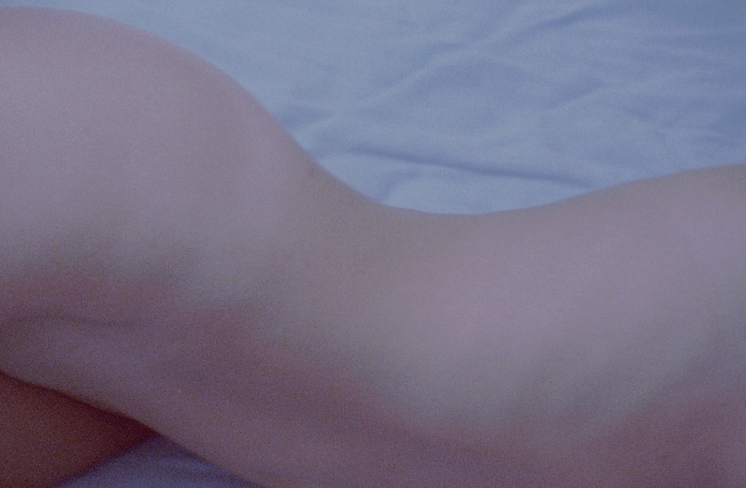
C: In the context of the Consumed series, we see the body being intertwined with nature and the landscape on an equal level. What was the dynamic that led you to develop these works as a series?
J.F: To be honest it is difficult to remember why Consumed ended up a series. It was a long time ago and I was working very rapidly. When I am done with a film, it is usually out of my mind. I will just stop when I feel something is finished. I think with Consumed, it just unfolded as a series, because I did not feel it was finished after the first film, nor the second, and so on. I probably did not plan it to be a series when I started it. With all of my films, the making of the film is an exploration. I follow where it takes me and I stop when the film it tells me it should end.
Consumed 4 (2001)
C: Insect seems to stand apart in this sense. It feels like an intense and sensory study of anthropology, and the use of the body also appears to take a different direction compared to your other works. Could we talk about a connection to anthropology in relation to Insect?
J.F: When I made Insect there wasn’t any connection to anthropology that I was thinking about. It was made similar to the other films at this time. It was very fast and basic. There was the body, the forest, and the dog. I used a very old camera for some scenes. There was an aquatic aspect with the shells and the whale sounds. The images and sound came to me and I just intuitively connected all of them together. If something anthropological is seen in the film, that is fine, it could be there. But I wasn’t aware of it at the time.
C: In some of your films, such as The Hemispheres and The Vanished, we encounter a recurring image of a doll. This was also one of the first things that caught the attention of everyone in our team. There is a long-standing connection between dolls and horror in cinematic language. Did you use this image as a way to contribute to the darker atmosphere of your films?
J.F: Sometimes I will be attracted to objects I find or just come across. I will want to use them and not really know what any meaning would be. Certain objects would just feel right to use and however they are interpreted by the viewer is fine. Maybe it is the same as what I said earlier, about the body in sculpture and painting. Because you have the camera, a synthetic body of the doll can dilute the cinematographic part and maybe reveal a hidden meaning. Later, I worked quite a bit with CGI figures and experimented with animatronic bodies because they were so completely artificial. But I was not thinking of the dolls in connection to horror cinema.
C: Do dreams and unconscious narratives have a place in your work?
J.F: Yes. Cinema simultaneously depicts the conscious, unconscious, and below the unconscious.
C: I notice that the atmospheres you create have not only a claustrophobic and dark side, but also a strong emotional quality. How do these elements come together in your filmmaking?
J.F: It is difficult to say how these elements of dark, claustrophobic atmospheres and emotional qualities come together, because I do not set out to create any specific atmospheres or emotions when making a film. I am intuitively bringing all the pieces of the production together, often very technically, to create an energy that is pushing to a result and it works like a magic. How it will turn out is a mystery. I do not analyze the process. So I can not know exactly how any elements specially come together. If the audience feels certain atmospheres or emotions, it is their own interpretation.
C: Another subject I am curious about is your relationship with painting. In particular, The Exiled Bird reminded me of Francis Bacon, perhaps also because of its structure and composition. While watching it, we felt almost as if we were looking through a collection of paintings. What’s the role of painting in your cinematic language?
J.F: I am not a painter, but in the period I made The Exiled Bird I created a number of canvases that I used like shots. These had paint, photographs, and latex fixed to them. At that time I was making everything for my films - props, costumes, makeup, special effects, prosthetics, and so on. The entire process was very physical. Also up to that point, I primarily had been working on film, so the process was also very mechanical to me. It had a certain weight to it, a heaviness. It was all machine oriented. Not just the cameras, but the editing and sound. So when I moved into video this all was gone. Even the lenses were gone, which to me was the basis of everything. And I was very attached to this mechanical process because I started it very young. At this time, I felt video was all very light and lacked this physical heaviness. And I did not think transferring the video to film was the right way to get this heavy feeling back. The video itself had remain purely video and this physical quality had to be within the actually video itself. So, when I first moved from film into video production, I think to compensate for the loss of this heaviness, I began to build a large amount of objects to use like shots to restore the lost physicality. It made me feel comfortable with the image.
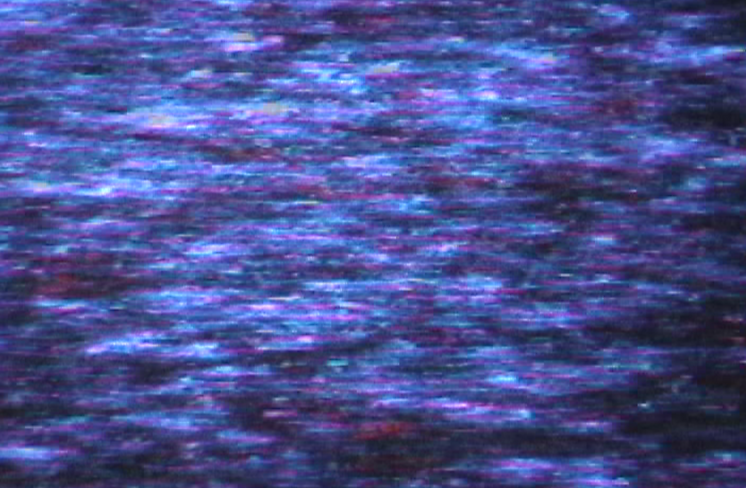
C: In Faces, we see rather primitive-looking drawings of faces accompanied by an image of a constantly moving sea, along with intense visual and sound manipulation. The editing creates a connection between these two elements and leads us to think about their relationship. What was the idea behind this structure and approach?
J.F: To be honest, these films at the time were made very quickly and the productions were bleeding into each other, so it is difficult to remember. I was building all the objects and canvases all at once. Then began the structuring of the films around them, if I am remembering this correctly. Faces I have no memory of making. But thinking back on it, I probably saw the lake moving and felt this image was correct to cut against the primitive faces. I can’t remember why I did the sound the way I did.
Faces (2003)
C: Apart from Growth and The Vanished, in all the films included in this program we notice that sound, from manipulated screams to various forms of noise and murmurs, plays a very important role in building the atmosphere. How would you describe the place and importance of sound in your filmmaking practice?
J.F: It is equally as important as the image. They are two separate worlds that co exist. Usually the images and sounds come to me at the same time.
C: As a final question, we would like to ask something slightly outside the context of the program. In some of your previous statements, you have mentioned your interest in early Hollywood cinema. This is also something we often hear from filmmakers working within experimental practices. Do you think these early forms of classical narrative cinema have a particular quality that makes them especially inspiring or nourishing for artists today?
J.F: I can’t speak to what any other filmmakers today might find nourishing about early Hollywood cinema. For me, this could be a complex answer because it could go in many directions with different directors, films, time periods films were made in, equipment used, and so on. To look at in a general way, it can relate to the earlier question of the conscious and unconscious. These films were like a phantom world, someplace in-between the shadows. The artifice of those films interests me. The immediate artifice. Also, the often simplicity of communication in the image. Many levels of information, emotional and intellectual, could be communicated instantly in this very artificial simplicity of the image. In both the presentation of characters and the locations, props - everything - often all within a single shot. This isn’t even touching on the narratives, which early on could be very short and they unfolded without the types of rationalization or logic that seems to be around today. The logic was often more hidden.


